- HEARING AIDS & HEARING CARE ACROSS SCOTLAND
- 01506 420519


Hearing Better on a Windy Scottish Walk
October 11, 2026
Keeping Up with Conversations at a Busy Edinburgh Café or Grassmarket Pub:
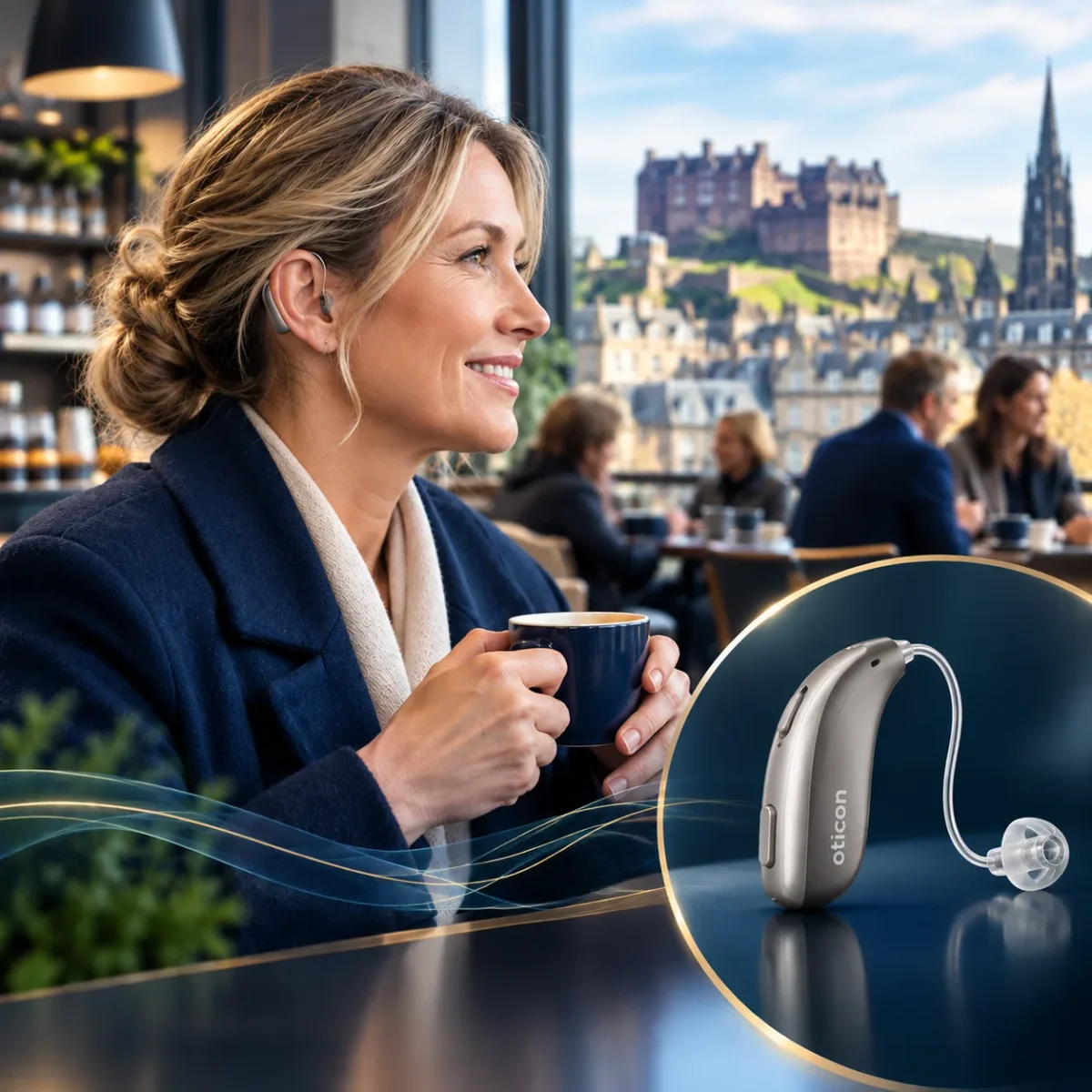
Picture this: You’re settled into a corner table at a bustling Edinburgh café on a Saturday morning. The espresso machine hisses, conversations overlap from every direction, the clatter of cups and plates fills the air, and outside the window the Royal Mile or Princes Street hums with tourists and locals. Or shift the scene to a traditional Grassmarket pub in the evening — the low murmur of voices rises and falls, someone laughs loudly near the bar, the TV in the corner carries the football, and a playlist of classic tracks sits just under the chatter. These are the everyday Scottish moments that make life rich. Yet for many people living with hearing loss, they can also be the hardest places to keep up.
Staying part of the conversation in noisy social settings is one of the most common challenges reported by people with hearing difficulties. The good news is that understanding why these environments are tough, recognising the specific patterns that appear in Scottish cafés and pubs, and using a combination of practical strategies and modern hearing technology can make a real difference. This guide explores those everyday scenarios and offers realistic ways to stay connected.
Why Busy Cafés and Pubs Are Particularly Challenging
Hearing loss rarely removes sound completely. More often it reduces clarity, especially for higher-frequency speech sounds that help us distinguish consonants. Background noise makes the problem worse by lowering the signal- to-noise ratio — the difference between the voice you want to hear and everything else competing with it.
In a typical café or pub the competing sounds are continuous and varied: multiple overlapping conversations, music, kitchen noise, chairs scraping, and the general hubbub of people coming and going. Scottish venues often add their own character — lively banter, regional accents that can be rapid or softly spoken, and the occasional burst of laughter or raised voice when the conversation turns to football, the weather, or local news. These environments demand a lot from the auditory system. Even mild or moderate hearing loss can leave someone nodding along while missing key words, or withdrawing because the effort of listening becomes exhausting.
Everyday Scenario 1:
The Busy Edinburgh Café
Edinburgh cafés range from quiet independent spots to high-energy places packed with locals, students, and visitors. A common situation is meeting a friend or relative for coffee. You sit facing each other, but the table next to you is deep in discussion, the barista calls orders, and a background playlist sits just loud enough to fill any silence.
Typical difficulties include:
- Missing the start of a sentence when the other person turns their head slightly.
- Struggling when the conversation moves quickly or when someone uses a softer voice.
- Finding it hard to follow when more than two people join the table.
- Feeling left out during the natural pauses and overlaps that happen in relaxed chat.
Practical steps that help in the moment:
- Choose a seat with your back to the noisiest area (kitchen, entrance, or speakers) so that the main conversation is in front of you.
- Position yourself so you can see faces clearly — visual cues from lip movements and expressions fill in a surprising amount of missing information.
- Politely ask people to face you when speaking and to avoid covering their mouths.
- If the café is particularly loud, suggest moving to a quieter corner or outdoor seating when the weather allows.
- Keep the conversation focused on one or two people at a time rather than trying to track a larger group.
These small adjustments reduce listening effort and make the social side of the outing more enjoyable.
Everyday Scenario 2:
The Lively Grassmarket Pub
Grassmarket pubs have their own distinctive atmosphere — warm, sociable, and often filled with overlapping conversations that rise and fall with the energy in the room. Whether it’s a Sunday afternoon watching the match, or an evening catch-up with friends, the acoustic environment is rarely quiet.
Common challenges here include:
- Difficulty hearing the person across the table when background chatter and music compete.
- Missing details when someone speaks from the side or when the group expands.
- Finding it harder to follow rapid, accented speech or banter that relies on quick timing.
- Feeling isolated when the conversation shifts to a topic you can’t quite catch.
Helpful approaches include:
- Sitting with your back to the bar or speakers so the main voices come from the direction your hearing is strongest.
- Choosing a smaller table or a booth if available, which can create a slightly more contained acoustic space.
- Letting friends know that facing you and speaking clearly helps — most people are happy to adjust once they understand.
- Using brief clarifying questions (“Did you say the match is on Thursday?”) rather than pretending to follow.
- Taking short breaks if listening fatigue builds up; stepping outside for a few minutes can reset your concentration.
Many regulars with hearing difficulties find that establishing a few simple ground rules with their usual group makes a noticeable difference over time.
How Modern Hearing Technology Supports These Situations
Today’s digital hearing aids are designed with exactly these kinds of environments in mind. Features that prove particularly useful in Scottish cafés and pubs include:
- Directional microphones and beam-forming technology that focus on speech coming from in front of the wearer while reducing sound from the sides and behind.
- Advanced noise reduction and speech enhancement that analyse the acoustic scene in real time and prioritise voices over steady background noise.
- Artificial intelligence and machine-learning algorithms trained on vast amounts of real-world sound data. These systems can adapt quickly when the environment changes — for example, when a café becomes busier or when music starts in a pub.
- Connectivity options such as smartphone apps that allow the wearer to fine-tune settings for specific situations, or remote microphones that can be placed closer to a conversation partner.
- Rechargeable designs and discreet styles that make consistent daily use more practical.
The key is proper assessment and fitting. A hearing solution that works well in a quiet room may need specific programming for noisy social settings. An experienced independent hearing aid audiologist can evaluate your hearing, discuss the environments you encounter most often, and recommend and adjust technology accordingly.
At The Hearing Aid Advice Centre I regularly help clients across Edinburgh, Glasgow, Livingston and the wider central belt of Scotland who want to stay involved in exactly these kinds of everyday moments. Because I am independent of any manufacturer, the focus stays on matching the right technology and settings to the individual rather than promoting one brand.
Building Confidence Beyond the Technology
Hearing aids are powerful tools, but they work best as part of a broader approach. Communication strategies matter. Friends and family can help by speaking clearly without shouting, facing the person, and reducing competing noise when possible (for example, choosing a quieter table or turning music down slightly). The person with hearing loss can also practise assertive but polite requests and give themselves permission to ask for repeats without embarrassment.
Many people also benefit from gradual exposure. Starting with shorter visits to familiar cafés or pubs and building up can reduce the sense of overwhelm. Tracking which situations feel easier after getting hearing support often reveals progress that might otherwise go unnoticed.
When to Consider a Hearing Assessment
If you find yourself regularly missing parts of conversations in cafés, pubs, family gatherings or other social settings, it is worth having your hearing checked. Hearing loss is often gradual, so people adapt without realising how much extra effort they are using. An assessment provides clear information about the type and degree of any loss and opens the door to practical solutions.
At The Hearing Aid Advice Centre the process is straightforward and pressure-free. I offer transparent pricing that is typically significantly lower than high-street providers on a like-for-like basis, a try-before-you-buy approach, lifetime aftercare and a manufacturer’s 5 year warranty. The aim is simple: help you hear more comfortably so that everyday Scottish life — the coffee chats, the pub banter, the shared stories — remains enjoyable rather than exhausting.
Staying Part of the Conversation
Busy Edinburgh cafés and lively Grassmarket pubs are part of the fabric of life in Scotland. They are places where friendships are maintained, news is exchanged, and ordinary days become memorable. Hearing difficulties do not have to push you to the edges of those moments. With realistic strategies, the right technology, and professional support tailored to your needs, it is entirely possible to keep up, join in, and enjoy the conversation again.
If noisy social settings have become harder than they used to be, consider taking the next step. A professional hearing assessment is the clearest way to understand what is happening and what can be done about it. Contact The Hearing Aid Advice Centre on 01506 420519 to arrange a consultation. Better hearing supports better connection — and that is something worth protecting in every café and pub across Scotland.
Colin Forrest is a HCPC-registered Hearing Aid Audiologist with over 23 years’ experience, providing independent hearing care and the latest digital hearing aids across Livingston, Edinburgh, Glasgow and Central Scotland at The Hearing Aid Advice Centre.